Aspiring apprentices sign up and access our AI Interview Coach for FREE!
From Music to Tech: How I Secured a Degree Apprenticeship with a <1% Acceptance Rate
I secured a tech degree apprenticeship with an acceptance rate of less than 1%—with over 600 applicants and only five selected, but it didn’t come easily.
What made it even more unexpected was my background. I hadn’t studied Computer Science or anything technical. My A Levels were French, Spanish, Music, and Biology and I was known for singing and performing jazz, as well as playing the saxophone , so, on paper, I wasn’t the typical candidate you’d expect to go into tech, let alone secure a role that competitive.
That outcome might sound impressive, but what matters more to me is how I got there. Before that, I was facing rejection after rejection, and I had started to internalise it more than I realised.
I was still determined to secure an apprenticeship, but my confidence wasn’t as high as it had been at the start.
By the time I applied to Salesforce, I was tired, discouraged, and running out of options. I had quietly decided that this would be my final application before stepping back and reassessing everything and that mindset alone could have cost me the opportunity.
Who I Am Today
I’m currently a Solution Engineer Degree Apprentice at Salesforce, working in AI tech sales whilst working towards my Digital and Technology Solutions Level 6 qualification. My work sits in high-impact, customer-facing environments where I build and deliver AI-driven solutions to organisations, solving their problems and boosting their efficiency.
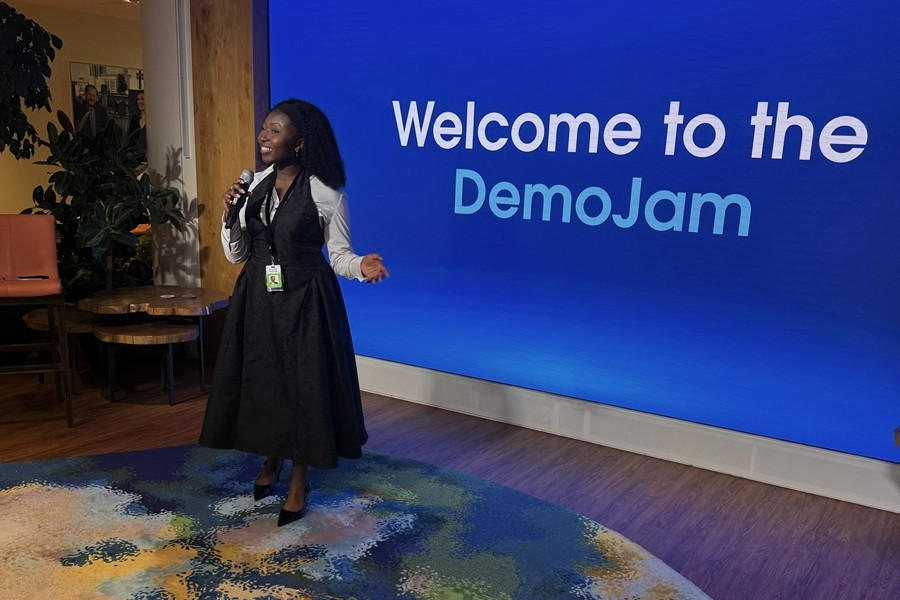
Alongside this, I’m an apprentice mentor and speaker. I’ve had the opportunity to speak at events such as a STEM Careers Fair at Tottenham Hotspur Stadium, and I regularly share insights around confidence, imposter syndrome, and what it really takes to step into opportunities you don’t feel fully ready for yet, from experience.
In my role, I’ve delivered 1:1 technical AI demos to senior stakeholders, supported
customer-facing solution work, and contributed to initiatives exploring how AI can be applied in sectors such as healthcare. I’ve also been trusted with facilitation work involving senior stakeholders, including roundtable discussions with executive-level leadership.
Choosing the Unconventional Path
By Year 12/13, I already knew I didn’t want to go to university. Which came as a surprise to my family, friends and teachers because I was predicted 3 A*s and an A and my teachers encouraged me to apply to Oxbridge and others encouraged me to apply to study Vocal Performance at a music school. But I knew I didn’t want to stay in classrooms and exams for years and then try to stand out afterwards. I wanted real-world experience, financial independence, and the chance to build something early. Degree apprenticeships made sense for the future I had in mind, so I committed to that path.
When Things Didn’t Go to Plan
I didn’t expect how difficult it would be to actually secure one.
I applied mainly for finance apprenticeships at first, simply because those were the ones I knew about. But I faced rejection upon rejection, and after a while, it stopped feeling like “just part of the process” and started feeling personal. In all honesty, I’d underestimated how competitive they were and assumed that my grades would be sufficient to get in, which led me to not prepare as rigorously as I should have.
By the end of my A Levels, I had no offers. University wasn’t an option I wanted, and most apprenticeship deadlines had passed. I found myself in a position I hadn’t planned for at all, a gap year. Which I initially felt was a bit of a let-down, but I realised that I could transform myself and my life in that year, given I put in the work and prioritised being aligned with God, Itrusting that if I focused on Him, He would order my steps. At first, it felt like I had fallen behind. But looking back, it was exactly what I needed.
The Pivot
That gap year forced me to slow down and reassess properly.
I started exploring different industries more intentionally, and that’s when I began to seriously consider tech. It wasn’t something I had previously seen myself in, but the more I looked into it, the more it made sense. The problem-solving, creativity, communication, impact, I realised it wasn’t as out of reach as I’d thought.
At the same time, I started to recognise that I had been underestimating my own experience.
I had worked in a Colombian restaurant since Year 11, where I had to adapt quickly, communicate under pressure, and rapidly improve my Spanish just to keep up. By Year 12, I had been promoted to manager.
I had also started a Gospel Choir at my old school, which grew into the largest choir there and became known across the borough and I became a Spanish tutor too, which all collectively helped me to afford a solo trip to Colombia - an unforgettable life experience.
None of this was “tech experience,” but it developed skills that mattered, communication, leadership, adaptability, resilience.
My gap year experiences are what made me memorable in interviews. Not everything has to be strictly industry-specific for it to be powerful. I got asked about my travel, choir and tutoring far more in interviews than my technical experience
Rejection Refined Me
Rejection forced me to be honest with myself. I realised that I wasn’t always putting in the level of effort or intention that these opportunities required. Not because I didn’t care, but because part of me didn’t fully believe it would work out anyway.
So I started preparing more proactively. I became more intentional with my applications, more thoughtful in how I communicated my experiences, more disciplined in how I showed up and deepened my company research.
A Different Approach
So when I saw the Salesforce apprenticeship opportunity, I approached it differently. I applied the feedback I’d received and prepared for my interview relentlessly, I practiced with other people, did my research on my interviewers, made sure I understood the role, the company, and how my experiences connected to it.
Throughout, I leaned on God and truly trusted that if I prioritised God, He would place me exactly where I needed to be, and I’m now living in the truth of that fact (Proverbs 3:5-6).
The Outcome
Out of over 600 applicants, only five of us were selected.
What changed wasn’t luck. It was a mindset shift and intentionality. Rejection had done its bit. It pushed me to become more prepared, more focused, and more aware of the value I brought, so when the opportunity came, I was ready to rise to the occasion.
Growing Into the Opportunity
I’m now in my second year, working in tech without a traditional technical background.
Since joining, I’ve had the opportunity to step into spaces I never would’ve expected to be in - delivering technical demos to C-suite professionals, delivering presentations on AI adoption in stadiums alongside the company CTO, building technical AI-driven healthcare solutions that will have real, life-changing impact and hosting and presenting at company-wide events.
One thing I’ve learned quickly is how much can change when you stop holding yourself back. I’ve seen it in my own journey, moving from support roles into presenting, leading projects that have real-world impact, being selected to represent the company at external events and continuing to grow into the role.
Alongside this, I continue to mentor and support aspiring apprentices, sharing what I’ve learned and encouraging others to go for opportunities they might not feel fully ready for. I believe giving back and being able to hold the door open for others to come is one of the main benefits of entering such a competitive space.
What I Learned
- Your background doesn’t define you.
- What you did at A Level doesn’t always limit your future options.
- Use rejection properly.
- Don’t just move on, reflect on your approach and improve something each time.
- Your experience counts.
- You’re building transferable skills everywhere, just learn how to talk about them.
- Go the extra mile.
- Check LinkedIn and YouTube for recent company updates and releases rather than just checking the website when doing company research, reach out to current employees on Linkedin
- Prioritise proximity and alignment with God
- When you rest in His will for your life rather than forcing your own, you find that in all things He works for the good of those who love Him and are called according to His purpose (Romans 8:28)
- Get a mentor
- Reach out to people where you’d like to be or even more senior - you’d be surprised how willing people are to help you, even if it’s just a one-off!
Kuziva Mazhude
AI Solution Engineer Degree Apprentice at Salesforce | Keynote Speaker | Vocalist | Podcaster
You can find out more and connect with Kuziva on LinkedIn.
Find Your Dream Apprenticeship!
Placer Apprenticeships connects the best apprenticeships with top talent.
You can find your dream apprenticeship in three ways:


Your AI Assistant
Chat with our AI to help you find matching opportunities and also answer any questions you have about apprenticeships.

Listings Search
Explore apprenticeship openings in all occupations and set up alerts for new opportunities delivered to your inbox.

Interactive Map
See a map of the UK with pins for all live apprenticeships, helping you zone in on matching locations and occupations.